
Trump Calls Foreign Factory Robots a National Security Threat, but No US Company Builds the Arms Detroit Uses
President Trump signed a proclamation declaring imports of industrial robots and machinery a national security threat, ordering 180 days of trade talks and holding tariffs in reserve, although US companies do not make enough of these machines.

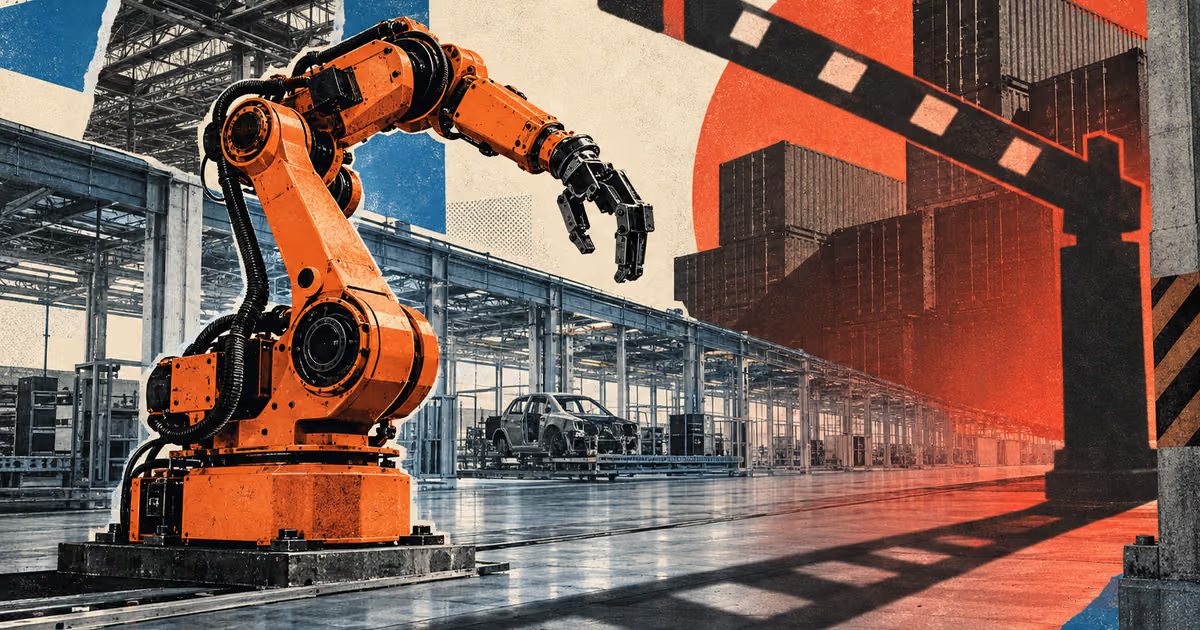
The heavy robot arms that GM, Ford and Boeing buy from abroad are now officially a national security threat. President Trump signed a proclamation on Wednesday, October 28, saying so about imports of industrial robots, industrial machinery and their parts.
The awkward part sits inside the proclamation itself. It admits US companies do not make enough of these machines to meet national security needs, and the White House fact sheet says the country "relies on foreign imports for most types of robotics, industrial machinery, and their parts and components."
So the threat is also the supply. And no tariffs have been imposed for now.
A 180-day clock
The order rests on Section 232 of the Trade Expansion Act of 1962, which lets a president restrict imports on national security grounds. Commerce opened the investigation on September 2, 2025, under Secretary Howard Lutnick.
Its conclusion: these products "are being imported into the United States in such quantities and under such circumstances as to threaten to impair the national security of the United States." Commerce also pointed to "unique security and safety risks" and "significant cybersecurity vulnerabilities" from components made by "certain foreign entities." It does not name them, and the proclamation names no country.
Lutnick and the US Trade Representative now have to negotiate agreements with whichever partners they choose and update the president within 180 days. If talks fail, the options include "tariffs, duties, quotas, and fees," along with a program to encourage new investment in US production.
The national security case is easy to state. The proclamation says these machines are needed to build aircraft, tanks, ships, weapons and munitions, and all 16 US critical infrastructure sectors use them.
The arms America doesn't make
The harder question is who would replace them. GM, Ford, Tesla, Boeing and Lockheed Martin rely on such robots, typically heavy arms from the big four of FANUC, ABB, Yaskawa and KUKA, which are headquartered in Japan, Switzerland and Germany.
No US company offers comparable heavy-duty arms, though the foreign makers have expanded their US engineering and assembly. Even Amazon, which has ramped up its own in-house robot production, still uses some FANUC arms.
Any tariff would land on the American companies importing those machines, raising the cost of the manufacturing the policy is meant to protect. Demand is not slowing either. The International Federation of Robotics counted almost 38,500 industrial robots installed in the US in 2025, up 12%, making it the second-largest market after China.
An exemption already on the books
In July, the FCC banned new models of foreign-made robots such as robot vacuums, robot dogs and humanoids, but it exempted industrial arms and fixed robots in car plants and warehouses. China threatened retaliation anyway. Ars also notes that Intel got a waiver to keep using foreign-made robots even under a nominal ban.
The push against foreign hardware keeps widening. Last week the FCC blocked its first gadgets over a single Huawei camera chip inside them, and Section 232 has already been used on steel, copper, pharmaceuticals and polysilicon, plus a semiconductor tariff and drone tariffs that reached 100% in August, with Europe capped at 15%.
Factory robots are a tougher target than dashcams, because the heavy arm on a Detroit assembly line has no American equivalent to swap in. The clock now runs for 180 days, and tariffs stay in reserve until it does.
Some offers on this page may be paid placements or contain affiliate links.
Subscribe to Techpresso
Free daily newsletter, read in 5 minutes.
Subscribe free