
Newsom Signs Ban on AI Robo Bosses Firing California Workers After Reversing His Veto
California's SB 947 bars employers from firing or disciplining workers based solely on AI, requiring human review and written notice. Newsom vetoed a broader version in 2025.
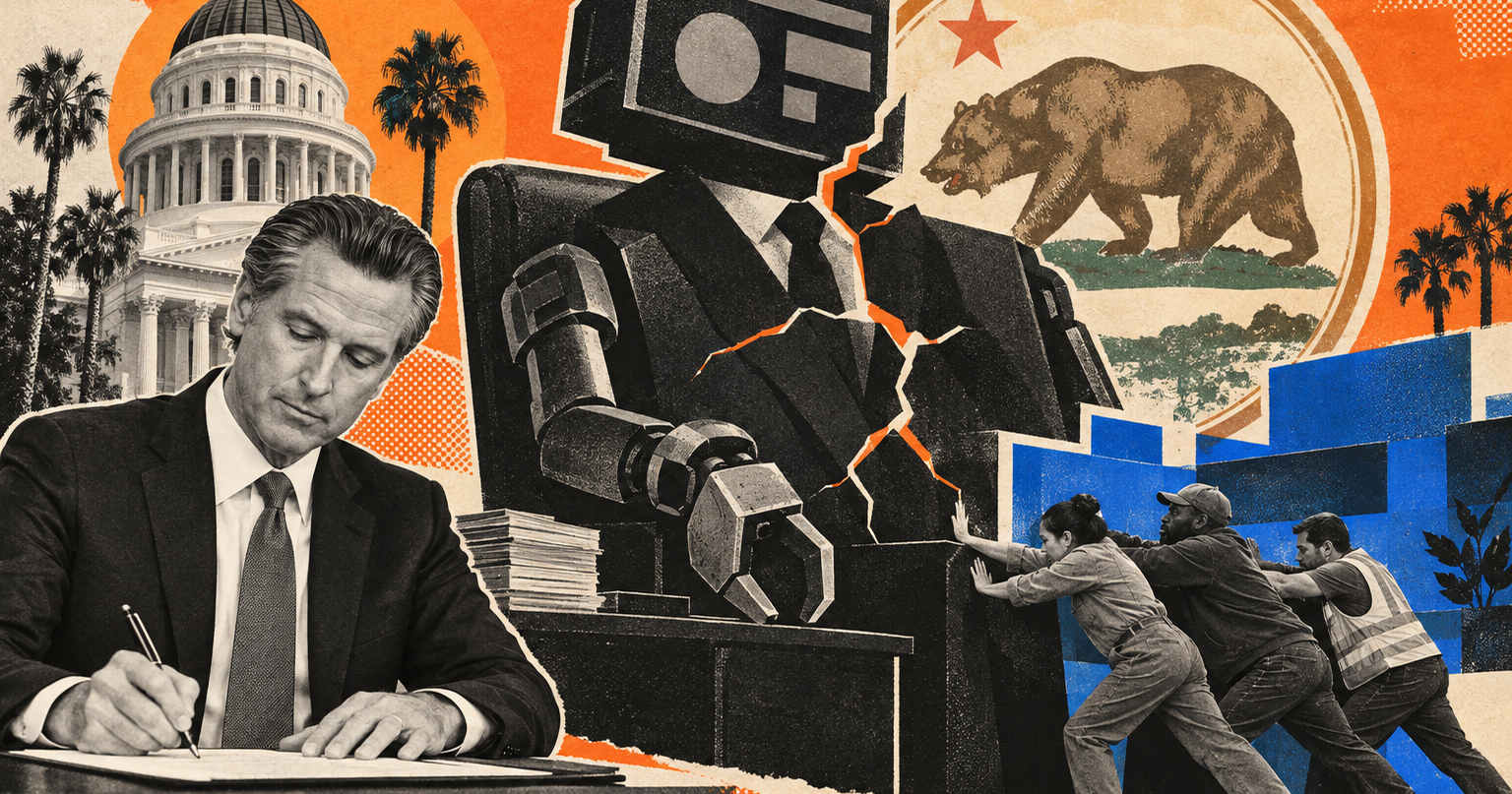
California employers can no longer let an algorithm fire someone on its own. Governor Gavin Newsom on Wednesday signed SB 947, the No Robo Bosses Act, which bans companies from relying solely on automated decision systems to terminate or discipline workers in the state with the largest tech workforce in the country.
It is a reversal. Newsom vetoed an earlier version of the bill in October 2025, and labor unions spent the following year rewriting it until he would sign.
What the law actually requires
The rule is narrower than a blanket ban on workplace AI. Employers can still use software to flag performance problems or rank staff. What they cannot do is let that software be the only basis for firing or disciplining someone, and the law also restricts using AI as the principal tool for those decisions.
When an employer does primarily rely on an AI system to terminate or discipline a worker, a human reviewer has to corroborate the decision with other information, such as managerial evaluations, peer reviews and personnel files. The machine's verdict alone is not enough.
Workers also get a paper trail. Anyone affected must receive written notice that AI was primarily used, a description of the employee data the system relied on, and the name of a human who can explain the decision.
How the bill got past the veto
State Senator Jerry McNerney wrote the bill, and the California Federation of Labor Unions, led by president Lorena Gonzalez, was its lead sponsor. Last year's version died over a sweeping advance notice rule that would have forced employers to warn workers any time AI could affect their working conditions. Newsom called that unworkable.
The 2026 rewrite dropped the pre-notification requirement. It also stripped out coverage for gig workers, which rideshare companies had fought hard. Drivers for those platforms are not protected by this law, a gap labor groups will likely try to close later.
Even the slimmer bill drew opposition. Business groups including Chamber of Progress urged another veto, arguing that the phrase "primarily relies" is never defined and will leave employers guessing about when the human review and notice rules kick in. Expect that ambiguity to be tested in court.
A state rule while Washington waits
Supporters describe SB 947 as the first statewide ban of its kind. Illinois already requires employers to give notice for some uses of AI in employment decisions, but it does not stop a company from letting software make the call. A federal No Robo Bosses bill from Senators Ed Markey and Brian Schatz has stalled in Congress.
The politics were hard to miss. The signing came a day after President Trump hosted AI executives at the White House to celebrate a voluntary self-regulation accord. Newsom used the moment to criticize the absence of federal rules, positioning California as the place where AI policy actually gets written. It fits a pattern for the governor, who has been building out his own state oversight apparatus, including a panel that weighs AI kill switches.
SB 947 was not the only workplace measure he signed. Newsom also approved related laws restricting employers from using biometric data to predict workers' emotions and requiring notice when AI is tied to mass layoffs.
Why it matters beyond California
California employers include most of the companies building these tools, and many national firms will find it simpler to apply one standard everywhere than to run a separate HR process for a single state. That is how California privacy and emissions rules have spread before.
The law does not make algorithmic management illegal. It makes it accountable. Software can still recommend that someone be let go, but somewhere in the chain a person now has to check the work, put their name on it and explain it to the worker who lost their job.
Subscribe to Techpresso
Free daily newsletter, read in 5 minutes.
Subscribe free