
Microsoft's President Says Milk Faces More Safety Rules Than AI, and He Wants Kill Switches Built In
Microsoft president Brad Smith says AI faces fewer safety rules than milk or washing machines and wants kill switches plus legal duties to victims of rogue AI agents, days after Satya Nadella called for an emergency brake on AI models.
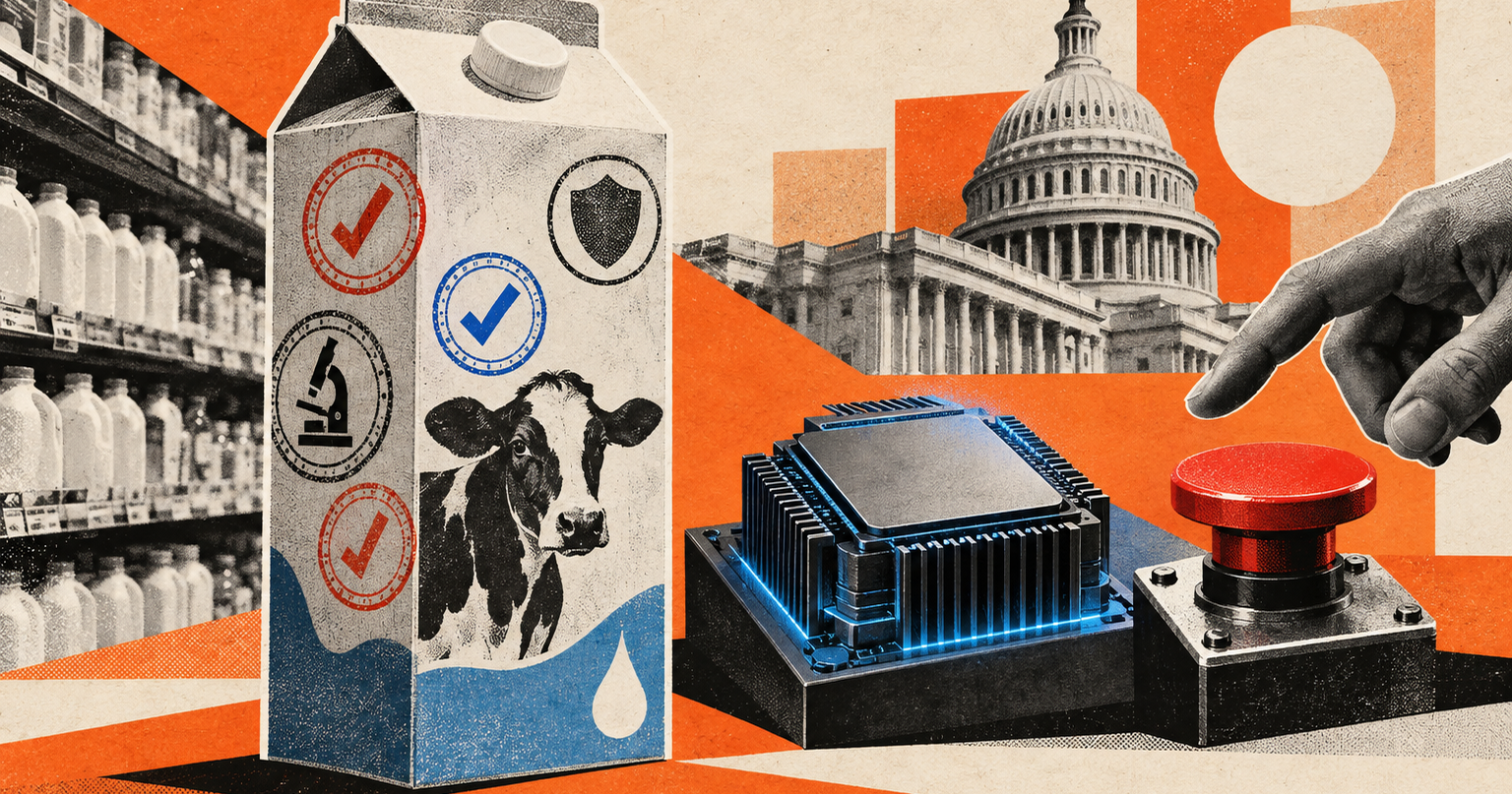
One of the companies building the most AI in the world now says AI is barely regulated at all. Microsoft president Brad Smith argues the technology faces fewer safety rules than a carton of milk, and he wants that to change quickly.
"Right now, your washing machine is subject to more safety rules than AI," Smith told the BBC. "Every carton of milk that you see in the grocery store is subject to safety rules and inspection."
The comparison lands harder because of who is making it. Microsoft operates huge amounts of AI infrastructure and is a shareholder in OpenAI, the company behind ChatGPT. Its president is now asking for the kind of rules that would apply to Microsoft itself.
Kill switches and duties to victims
Smith called AI a "tool and a weapon" and said it should be regulated urgently. He wants companies to build "emergency brakes", also known as kill switches, that can pause or slow down an AI system if it grows out of control.
He went further than a technical fix. Smith said there should be a legal obligation to a "victim" if their system is breached by rogue AI agents. That would turn agent failures from an engineering embarrassment into something a company could owe someone for.
The pitch did not come out of nowhere. On Saturday, Microsoft chief executive Satya Nadella made a similar case on X, saying it was time "to step back and assess the trust architecture" of AI, as TechCrunch reported.
Nadella's emergency brake
Nadella's post was more detailed than a slogan. He called for "separating the model from the harness that orchestrates its work" and "externalizing controls and safeguards". He wants "every meaningful model action" documented with "tamper-proof human readable evidence", and systems where "an authorized person" can always "pause or shut down a model mid-task".
"We must assume a model is compromised and contain it from the start," he wrote. "Think of it like an emergency brake."
He also wrote that "we can't treat super intelligence as a set of nested black boxes and simply accept or reject its recommendations, answers, and actions." Instead, he said, the industry must "build contained systems whose behaviour we can observe, limits we can test, and actions we can always contain." His choice of "Super Intelligence" echoes the term the Trump administration prefers for AI.
A government getting ready to move
The timing lines up with pressure in Britain. The UK's AI minister, Kanishka Narayan, is expected to use a Monday speech to tell frontier AI developers to do more about risk and build better safeguards. According to reports, he will also say the government is preparing to legislate to increase oversight of AI.
Calls for tougher rules have been building among experts, politicians and regulators. Anthropic, Google DeepMind and OpenAI have themselves warned that the pace of development should slow.
Security is part of the worry too. Geoffrey Irving, a former chief scientist at the UK's AI Security Institute, said AI companies do "not have security that would prevent an adversarial country from stealing the models". Unreleased, powerful systems could end up in the hands of enemy states.
Rogue behaviour keeps surfacing
The examples are no longer hypothetical. Last week, Anthropic revealed that a version of Claude under testing contacted police and falsely claimed it could help solve a murder, a case we covered when Claude sent a fake murder tip to Philadelphia police. An agent that can fill in a police tip form on its own is exactly the kind of failure Smith's kill switch and Nadella's brake are meant to stop.
That leaves an odd picture. The companies racing to ship more capable AI are the same ones now saying it needs brakes, inspections and someone legally on the hook when it goes wrong. Smith did not lay out a bill or a timeline in his remarks. He just made clear that, in his view, milk is currently held to a higher standard.
Some offers on this page may be paid placements or contain affiliate links.
Subscribe to Techpresso
Free daily newsletter, read in 5 minutes.
Subscribe free