
After Years of US Chip Bans, China Moves to Lock Its Own Top AI Models and Chip Designs Behind Export Controls
China proposed adding large AI models, agents, computing clusters and advanced AI chip designs to its export control list, and made pre-export registration mandatory from October 16 while the draft is open for comment.

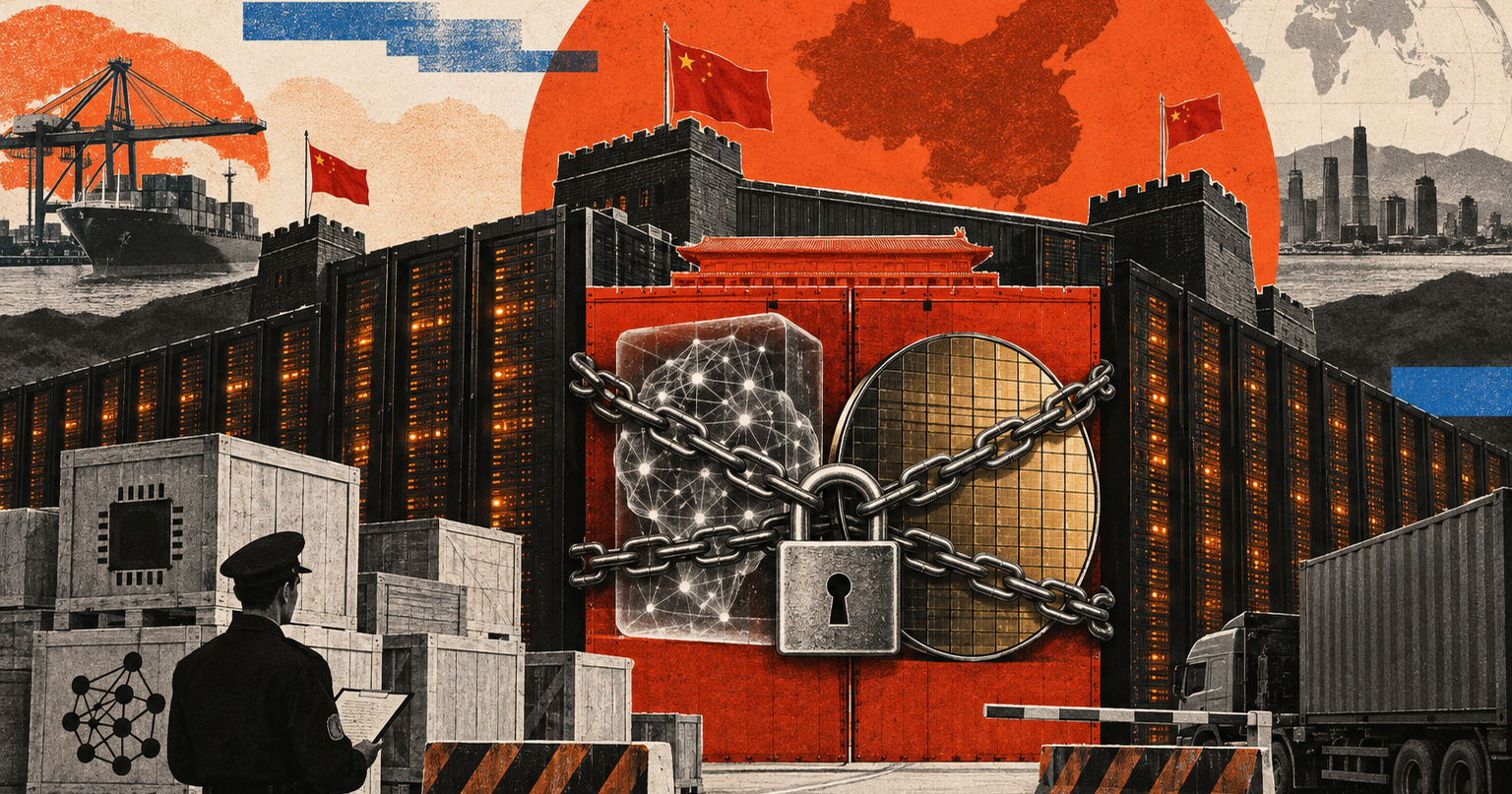
For years the story ran in one direction. Washington cut China off from advanced chips, and American officials accused Chinese labs of copying US models. On Friday Beijing drew a border of its own. China's Ministry of Commerce and Ministry of Science and Technology proposed putting the country's biggest AI models, AI agents, computing clusters and advanced chip designs on its list of technologies whose export is prohibited or restricted.
The rule is still a draft. But one piece of it is already live: a temporary pre-export registration requirement that took effect the same day.
What would be locked
The draft adds 40 technologies to the export catalogue. Artificial intelligence takes 23 of them, covering large models, agents, computing clusters and information processing. Biomedicine gets five, including cell and gene therapy and small nucleic acid drugs such as siRNA. Photovoltaics gets 12, from polysilicon to wafer and cell manufacturing and the key equipment behind them.
For large models, the curbs would reach the weights, source code and other core technology of models trained on "important data" that have at least 2 trillion parameters, or that rank among the world's top 10 on measures including performance, usage and safety, according to Bloomberg. The draft names no model. Bloomberg pointed to Moonshot AI's Kimi K3 and Alibaba's Qwen3.8-Max as examples already above that size.
Chips are in it too. Design technologies for AI chips made at 14 nanometers or more advanced, or built with 2.5D or 3D advanced packaging, would be covered, along with design know-how for certain advanced memory chips.
What stays open
Beijing is not slamming every door. AI technology already public through open source or academic papers is excluded. So is access through APIs, websites, apps and software-as-a-service platforms, which means overseas users can keep using Chinese models through apps and APIs, TNW reports. The ministry said most AI technologies would remain freely exportable.
The tricky part is what counts as an export. Deploying a covered model on servers abroad would qualify. Chinese companies running their own computing centres overseas would get simplified or automatic licensing, and open-source exports would get simplified licensing as well. In biomedicine, transferring IP ownership of some novel cell and gene therapies and siRNA drugs would be banned outright, while licensing deals that keep ownership in China would be eased.
Registration starts now
The comment window runs from October 16 to November 15. Until the catalogue is formally revised, the temporary registration rule applies, and it reaches back into deals already underway but not completed. That includes IP transfers, overseas licensing and changes that would put Chinese technology owners under foreign control, the Wall Street Journal reports.
That is the immediate catch for deals already in motion, from overseas licensing of Chinese technology to a foreign buyer taking control of a Chinese tech owner. The paperwork applies today, before the final rule exists.
The official reason, and the obvious subtext
A ministry spokesperson said the rules aim to "prevent misuse and abuse" and "ensure that AI remains under human control." The ministry pointed to risks such as AI capable of generating and deploying autonomous malware against critical civilian infrastructure, and said the plan does not target any country or company.
The geopolitical reading is hard to miss. Reuters framed the move as Beijing's latest effort to limit transfers of tools it sees as vital to national security and its competition with Washington. The Financial Times had reported in July that Beijing was weighing controls on AI models and chips. PCMag called it an ironic twist: after years of US curbs and complaints about copying, China is now restricting access to its own AI.
The timing sharpens that irony. Last month US security agencies accused DeepSeek, Alibaba and four other Chinese AI firms of industrial-scale distillation of American frontier models. Now Beijing is the one treating model weights as strategic assets that cannot simply walk out the door.
For Chinese labs, the draft adds another layer of uncertainty to an industry that already works under strict content controls, Bloomberg noted, and it lands just as those labs keep training ever larger models. The bigger they get, the more of them will cross the 2 trillion parameter line and fall under the state's export gate.
Some offers on this page may be paid placements or contain affiliate links.
Subscribe to Techpresso
Free daily newsletter, read in 5 minutes.
Subscribe free