ChatGPT Keeps Signing Real New Yorker Cartoonists' Names to Fake Cartoons, Even After OpenAI Was Warned
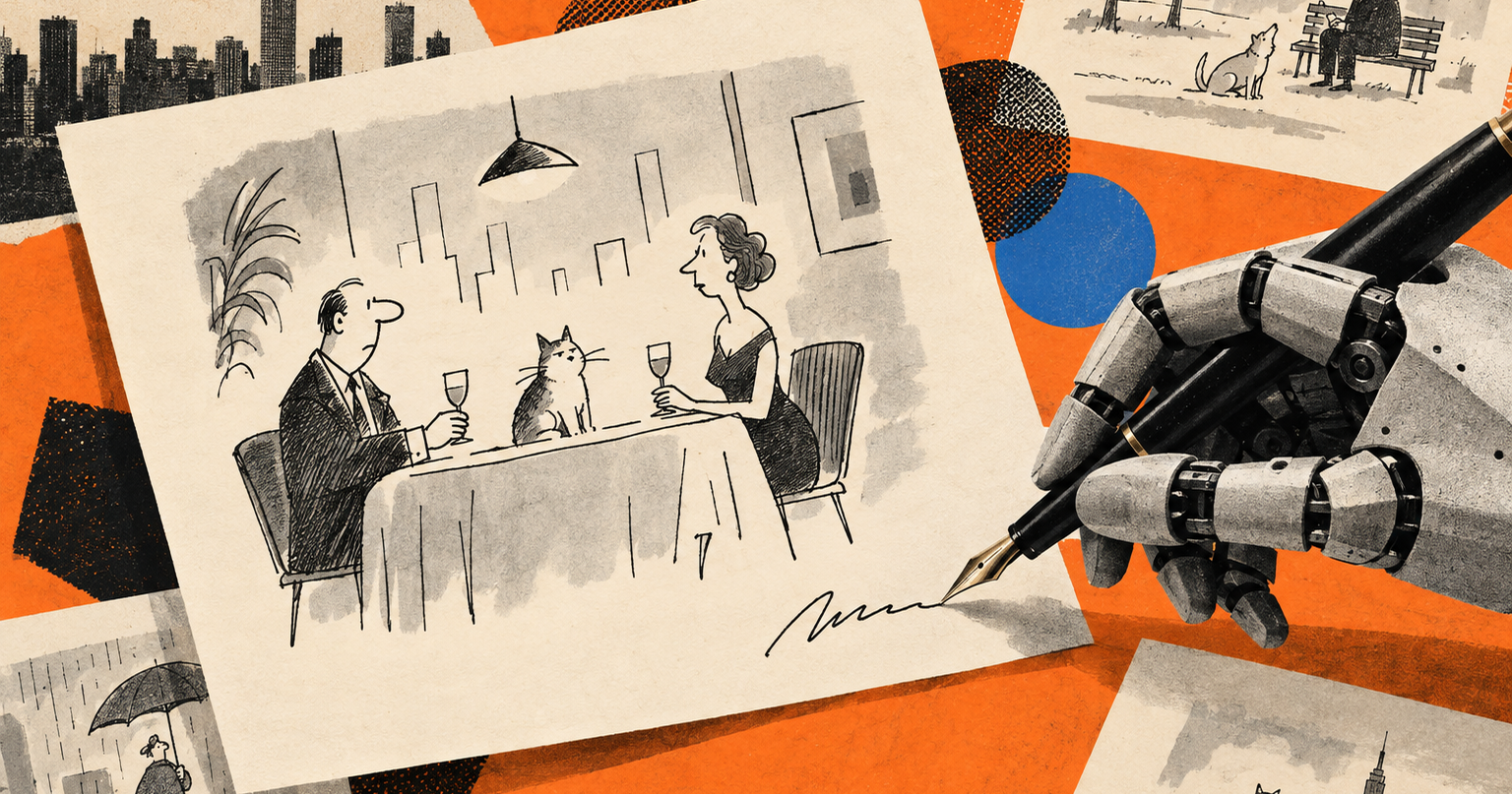
ChatGPT isn't just imitating The New Yorker's cartoon style. It's signing real, working cartoonists' names to drawings they never made, and OpenAI's fix so far is a warning label.
In late August, after the deaths of Dolly Parton and Tim Curry, a cartoon went viral. At the pearly gates, Parton in a sparkling gown stands arm in arm with Curry dressed as Dr. Frank-N-Furter, telling God at heaven's reception desk, "I knew I chose the right plus one." One tweet got 25,000 likes, and versions spread across Facebook, Instagram and Bluesky.
In the bottom right corner was "BLOPER," the pen name of New Yorker cartoonist Brendan Loper. He didn't draw it and he didn't sign it. ChatGPT did. The Dolly Parton fan who first posted it on Facebook said she had simply asked the chatbot for "a New Yorker-style cartoon."
"I had people writing to me about this cartoon, asking if it was mine," Loper said. First came a text from his twin brother, then emails and DMs from strangers. "It was very surreal."
Not a one-off
It had happened before. In May a stranger warned Loper on Instagram that his pen name had turned up in a ChatGPT image, and over the summer he found more examples in a Reddit forum about the chatbot.
"I'm not a territorial person, but my name is my name," he said. "It felt very much like a violation of my personhood." For cartoonists, the signature does real work. "The signature for me is the certificate of authenticity," Loper said. "If I put my name on it, it's official, it's mine." Online, where images get stripped of their context, it also works as a watermark tying a drawing back to the person who made it.
Loper is far from alone. A Nieman Lab investigation found more than 15 New Yorker cartoonists whose signatures ChatGPT's image generator used without permission or payment. Forum images carried the names of Harry Bliss, Emily Flake, Joe Dator, Pat Byrnes, Peter Vey and Jason Adam Katzenstein. Nieman Lab's own tests turned up George Booth, Liza Donnelly, Ellis Rosen and Saul Steinberg, along with older contributors like Warren Miller, who published in the 1960s. Not every image was signed, and some signatures came out as gibberish.
"I can see the DNA of my work in there, but it still doesn't look like something I drew," said Flake, who has contributed to the magazine since 2008. "It's kind of like seeing a distant cousin." She added: "It's like somebody attributed a quote to me that I didn't say."
Katzenstein, published in The New Yorker since 2014, was blunter. "It's an uncanny simulacrum of an impression of a joke," he said. "The point is that it's trying to deal a death blow to labor. It's trying to render individual cartoonists obsolete because we cost money and take time."
OpenAI's patch
OpenAI said in a statement that "the future of creativity is one that is fundamentally human," and that it appreciates "the community flagging bugs and unintended behavior by our models, so we can address them." It declined to explain how its models picked up the signatures in the first place.
After OpenAI was notified, ChatGPT started showing a warning for New Yorker-style requests: "This prompt may violate our guardrails concerning similarity to third-party content." But at the time of publication it was still signing some generic cartoons with real cartoonists' names. Some outputs also reproduced The New Yorker's logo.
That sits awkwardly with the paperwork. Condé Nast, the magazine's parent, signed a multi-year licensing deal with OpenAI in 2024, but a New Yorker spokesperson said the company has never given any LLM developer permission to train on its cartoons, and logo use isn't allowed in any of its AI deals. The cartoonists themselves work freelance on spec, get paid only when a cartoon is picked, and keep their copyright. The contracts Nieman Lab reviewed don't allow licensing their work for AI training.
Publishers are already fighting OpenAI over training data, from the newspapers suing OpenAI and Microsoft to the broader copyright appeals working through the courts. The cartoonists' complaint is stranger and more personal. The chatbot isn't just borrowing a house style. It's putting working artists' names on pictures they never made, and so far the fix is a label that doesn't stop it.
Subscribe to Techpresso
Free daily newsletter, read in 5 minutes.
Subscribe free